The Magic Between the Frames
Filmmakers have always chased time. From the earliest hand-cranked cameras to the high-speed Phantom Flex, the ability to slow down reality reveals a world of beauty invisible to the naked eye. But historically, this required expensive hardware capable of shooting at 120, 240, or 1000 frames per second (fps).
If you took a standard 30fps video and slowed it down, you got a slideshow. The motion was jerky and stuttery because the visual information simply wasn’t there.
Enter AI Frame Interpolation, a revolutionary technology that allows us to create slow motion from standard footage. At iSamurai, we use this technology to turn your everyday videos into epic cinematic moments. But how does it actually work?
Table of Contents
Understanding Optical Flow
Traditional software interpolation (like “Frame Blending”) simply fades Frame A into Frame B. This looks like a ghosting effect—blurry and unconvincing.
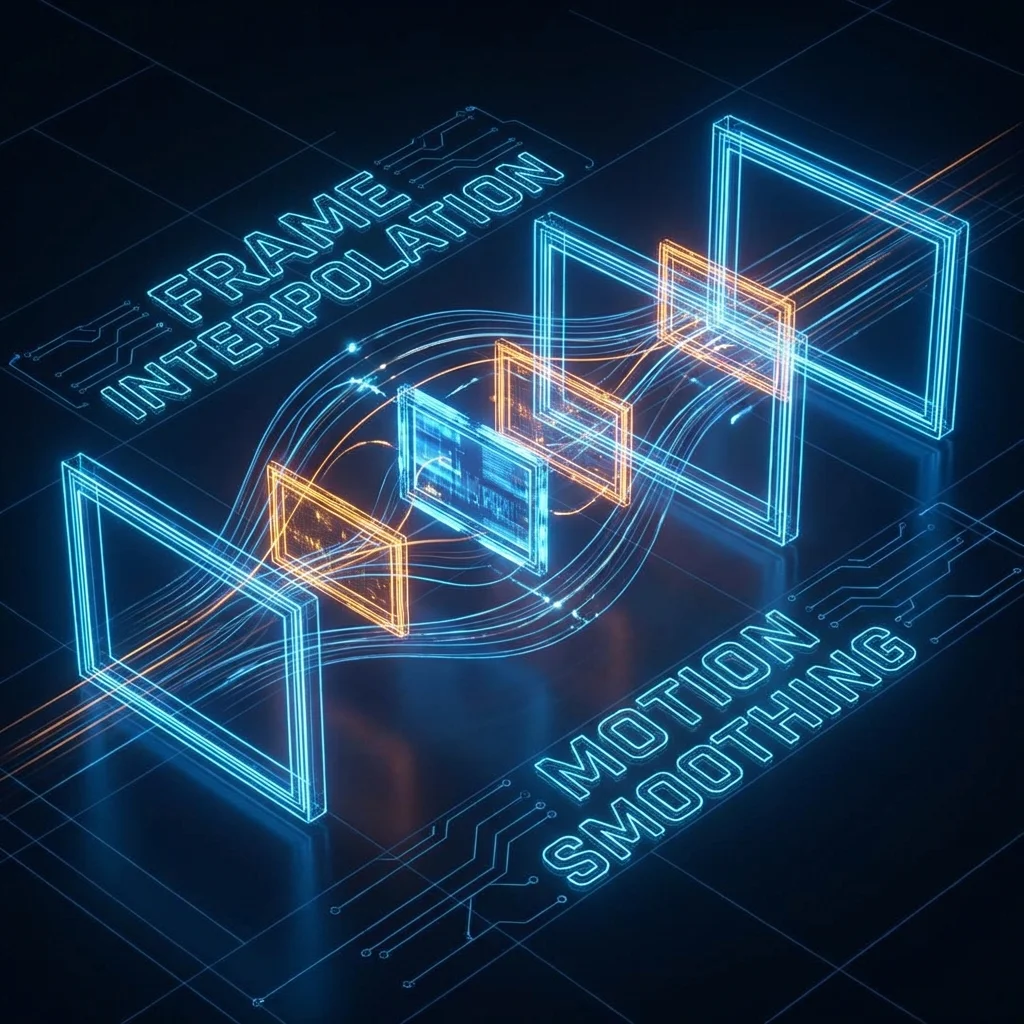
AI Interpolation (specifically Deep Learning models like RIFE – Real-Time Intermediate Flow Estimation) does something much smarter. It “sees” the objects in the scene.
1. Analysis: The AI looks at Frame A (a car at position X) and Frame B (the car at position X+10).
2. Estimation: It calculates the “Optical Flow”—the vector direction of every pixel moving between the frames.
3. Synthesis: It hallucinates a brand new image (Frame A.5) where the car is exactly at position X+5.
This isn’t just blending; it is generative creation. The AI is literally painting a new moment in time that the camera never captured.
The Challenge of Complexity
While the concept sounds simple, the math is incredibly complex. The AI must handle:
* Occlusion: What happens when a person walks behind a tree? The pixels disappear. The AI must know not to morph the person into the tree.
* Non-Linear Motion: Nothing moves in a perfectly straight line. Arms swing in arcs; balls bounce. Advanced models predict these curves to prevent “jelly” artifacts.
* Lighting Changes: If a light flickers on between frames, the AI must smooth that transition.
Why GPU Power Matters
This pixel-perfect prediction requires massive computational resources. To interpolate a 10-second 4K video from 30fps to 120fps (4x Slow Mo), the AI must generate hundreds of brand-new 4K images.
Doing this on a phone is slow and kills battery life. That’s why iSamurai runs these models on cloud-based NVIDIA GPUs. We can process complex optical flow calculations in seconds, delivering professional results without heating up your device.
When to Use AI Slow Motion
AI Slow Motion is a tool, not a magic wand. It works best when:
* Backgrounds are clean: Complex, chaotic backgrounds (like rushing water or heavy rain) are harder for the AI to track.
* Motion is predictable: Sports, dance, and running are perfect candidates.
* Shutter speed is high: Motion blur in the original footage can confuse the AI. Crisp frames yield the best interpolated results.
The Future of Time
We are entering an era where frame rate is no longer a fixed constraint of the camera. Just as AI upscaling unleashed resolution, AI interpolation is unleashing time. With iSamurai’s Slow Motion Tool, you can revisit your old footage and see it in a whole new light—slower, smoother, and more epic than ever before.
Related Tutorials & Features
- Generate your own slow motion video: Try AI Slow Motion
- Learn to use our slow motion tools: iSamurai Slow Motion Guide